Tuesday, June 15, 2010

'My Name is Black'


I was born in 1555 in Istanbul. My father was a preacher and a teacher of religious texts. He travelled to many places and occasionally returned to Istanbul. He was not in good terms with my mother even in his small stays with us. This made my mother and I took refuge in the house of my mother's younger sister, fearing his cruel treatment to my mother, whose husband is a miniaturist. I called him Enishte, in whose house i saw my cousin Shekure and fell head over heels in love with her. She was twelve years younger than I. I died in 1617. I was resurrected back to life in 1998 by a Turkish Man, who won the Nobel Prize in Literature in 2006 for many of his literary achievements including the exhumation of me back to life. Now I live in 'Benim Adim Kirmizi'. I was born to the English audience in 2001 in the book 'My Name is Red'. You can meet me, if you happen to buy a copy, or even borrow from many of the resources, (you may even think of stealing) of the translation 'My Name is Red'. Thanks to Pamuk, who is presently a teacher in Columbia University, i am known to so many. Let me briefly narrate my story.

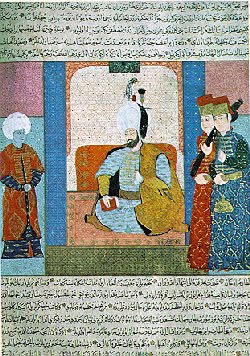
I returned to Istanbul after wandering in the Ottoman Empire for twelve years having several stints as clerk, bearer of messages, errand man to Pashas and Clerics and Sultans. I chose to be a clerk and did not want to be a miniaturist and a gilder of paintings. My uncle whom you know as 'Enishte' was very much interested in teaching everything about miniature paintings. Two things deterred him from doing so. My imperviousness in knowing and understanding the technicalities of style in painting and my falling in love with his daughter. Shekure was twelve and i was twenty-four but she was the more matured of the two. Sultan Murat III was the ruler of Istanbul when i returned to Istanbul. He was interested in painting and had summoned my uncle secretly in making a book of miniature-paintings. One of the painters or miniaturists was murdered a couple of days before my arrival. He was 'Elegant Effendi', good at gilding and decorating paintings. My uncle sought my help knowing about my return to Istanbul in completing the secret mission, though i was not a good miniaturist or rather even a drawer of images. To be honest what brought me to Istanbul was the countenance of my dear Shekure, which i almost forgot after three or four years after my departure. She fell in love with a Spahi Cavalryman and married him and now was the mother of two boys.

After my return, i first saw her face through a window. She sent me letters through the Jewess. Her husband had been missing for four years now, never returned from war and she had spent a few years in her in-law's house, where she was parrying the overtures of her husband's brother Hasan. She came to stay with her lonely father after sometime. I was a bit confused at the outset reading her letters that whether she was in love with me or not. She returned to me the kerchief i made for her with the drawing of Husrev and Shirin from the story of the twelfth century poet Nizami Aruzi. My love towards Shekure was responsible for me accepting the task from my Enishte for the completion of the secret book. Sultan Murat III summoned my uncle to do a book of miniature paintings that would depict his achievements and contain his self-portrait, a great sin according to Prophet Mohammad and tenets of Islam, on the model of Franks and Europeans. The final picture of the Sultan was responsible for the death of 'Elegant Effendi'. I faced a lot of hardships due to the task i undertook for my love. My uncle was murdered and i was arrested on suspicion. The great miniaturist of that time Master Osman was entrusted with the job of finding the killer.

The killer had left a trail in the well where he had dropped the corpse of 'Elegant'. There was a portrait of a horse which should have been drawn by one of the apprentices of Master Osman. Three of the apprentices were highly talented and nicknamed 'Butterfly', 'Stork', 'Olive'. Olive was a Persian Miniaturist who was also a purist and never wanted the old works of great masters like 'Bihzad' and others to have been polluted through the violation of techniques of them and blind immitation of the works of the infidels (Franks and Europeans). After much struggle, he was caught and he was eventually murdered by my archenemy Hasan. In the meantime, the two of the boys grew hostile towards me and with much effort I was able to gain a position of getting accepted by them. I realised my long dream of thirty-six years marrying Shekure and living with her for twenty-six years. I thank the Turkish Master-Story teller Orhan Pamuk for writing about me and my love with Shekure, which was the one like that was depicted in the miniature paintings on the love of 'Laila and Mejnun', and 'Husrev and Shirin'. The legend has it that Shirin fell love on seeing the painting of Husrev that was hung on the branch of a desolate tree. I got elevated to such position through the story of mine by Pamuk. If you want to know more about style, schools and miniaturists of Ottoman Empire and Persian Empire with the mingling of Mingian and Chinese Style, do read my story as told by the Turkish Master, Pamuk.

Wednesday, June 2, 2010

Ruma's Story


I first read Jhumpa Lahiri some two years ago, though her first collection of short stories that won the covetous Pulitzer Prize, 'Interpreter of Maladies' was published well over a decade ago. Her charming writing did contain a great luring effect to trap the readers. I am fascinated with her style of writing and i have enjoyed almost all of the stories in that collection. Most, in fact, all of them featured Bengali protagonists. I remember a story in which the main character, a plump woman of thirty comes to stay in an apartment and she does not find any real human to care her. Her intention is to get married and eventually engender children. She is one of those people that we come across in our daily life whom we detest to move with and we do not deign to accept their existence. In an another story a couple who lives in the US does sort out their strained relationship through the grid transformation work of the electricity department. As they sit in darkness at night, nothing else to do in power failure they are reminded of their life immediately after their marriage. A week of grid rectification augurs well in transforming their lives. In another of the stories, a woman who is in love with a married man thinks twice and finally snaps her ties with after visiting the house of another friend who has been ditched by her husband and moving with the young boy of hers.

The attraction to read Lahiri lingered afterwards and i read her much acclaimed novel, 'The Namesake', late after being it was made into a film by Mira Nair. Fortunately i had not seen the film before i read the novel. It was published in 2003 and the film adaptation came in 2007. It discusses the generation gap between the settlers and those who are born in alien soil. Nikoloi Gogol, the namesake of the famous Russian writer was born in the US and does not cling on to the customs and traditions of Bengalis, quite naturally. On the whole it is more less a comment on the inherent liking to go scot-free and freak out on the part of the parents getting reflected in their wards as the wards live in a different and conducive atmosphere to execute their wishes. I am reminded of a Tamil Novel by Sivasankari. The name is 'Paalangal' (Bridges). In it she juxtaposes the lives of three different women who represent the thirties, sixties and the eighties respectively. The novelist does not comment on the actions of the women and just details their lives.


Lahiri's latest is 'Unaccustomed Earth', which is also the title of the first of the stories, a set of short stories, that she is good at writing rather than a big story of more than two-hundred pages. The first is a big story of Ruma, a law professional who lives in Seattle with her husband Adam, a Hedge Fund Manager. The story begins with the description of the European tours that her father, a seventy year old, retired chemical factory employee and a widower undertakes to enjoy himself. He does not communicate to her daughter the place of his stay in Europe, but occasionally sends 'Tourist Post Cards' indicating glimpses of his experience. Ruma is the elder of the two children born to the Bengali Couple who migrated to Pennsylvania from Calcutta. Romi, her brother now lives in New Zealand with his wife. Ruma married Adam, an American (a White) four years ago and is now expecting her second child. Akash, the first one is three years old. Rumi yearns for a companionship that she believes her mother's sudden demise has taken a toll on her. The American does not mind her father to be with her. However the father is in no interest to be part of any family now and he is in good health to take care of himself and has made surprising decisions after his wife's death to go on European tours, to have sold his house without informing anyone.

Rumi is of the opinion that her father never appreciated her mother's work who was a traditional house-wife and a good cook. She wanted to visit Europe which she had flown over many a time on her way to Calcutta. He stood impervious to all her wishes and it was Rumi who arranged for trip to Europe. Unfortunately she died all of sudden, not bearing the anaphylactic drug injected to perform gall bladder operation. Her father now has a new Bengali friend, an old lady in her early sixties, who loved a young man in Calcutta, married and lost him in an accident two years later. She came to the USA and became a professor and never married afterwards and lived all alone. In this context the father visits the new, splurging house of Rumi in Seattle. His stay there for a week kindles the feeling in Rumi of having a great protector. He builds her a garden and plays with his grandchild and wants her to take up her profession once again as he is always afraid of the American marriage being flaccid. He does not want to discuss his new friend whom he became close with in his trips. He writes a post card to her and puts it into the Seattle Map Book and the boy takes it out and plants it in his garden. The father does not stay after his scheduled visit and Rumi comes to know of his new companion only after he has left, through the un-posted letter. Rumi is reminded of herself and her brother when they were young, how they wanted to be free and not wanted their parents to intrude. Now, she needs to be with him. She thinks that her mother would have done in case of her being a widow. In the end, she realises her father's intentions and posts the letter to the address. A fine denouement that clearly portrays the planes of every character. A much matured writing by Lahiri is seen in her latest production.

Friday, May 28, 2010

Theyyam


One of my recent earlier postings was on 'Atchaya Trithiai'. One of my friends and a regular commentator on my views has questioned about the recent book that i bought on the occasion of 'Atchaya Trithiai'. Since the last of the atchaya trithiai came on a Sunday, i was unable to buy any books. A couple of days ago i visited a book shop in Madurai and picked out a non-fiction, travelogue, documentary in words kind of book by a Scottish writer. He has settled in New Delhi and is known for his number of books on Indian life-style, on Mughals. He is also a presenter of documentaries. His name is William Dalrymple. His recent book is NINE LIVES. I have seen his travel documentaries a lot. In fact, in my last visit to one of the book shops, i was almost to buy his book on Mughals, but withdrew from it as it was quite voluminous and at that time i was not in a mood to read big books. I was very wrong in not choosing that book since the book i bought, NINE LIVES, has proved to be a remarkable one, both in content and language.

The book contains nine articles written on nine personalities that he met with in India. According to him the idea of the book came to him some sixteen years ago, when he was in Gangothri, on his way to Kedarnath. There he met a 'Naga' Sadhu. The sadhus do not have any material possession and roam naked in holy places. However, this one happened to be an MBA graduate with a lot of experience in marketing, who all of a sudden left his job and relinquished his possessions and became a Naga sadhu. This struck the writer on the position of austere practices of religion and their survival in the modern, scientific India. Sixteen years of his travel all over India has given him enough food to think of a book that to an extent tries to answer some of the questions on the existence of some bigotry.

The second story is named 'The Dancer of Kannur'. It is on Hari Das, a Dalit Theyyam performer. Theyyam is a dance like Kathakali performed with the goat-hide 'Chenda' Melam. The dance form is popular only in the northern parts of Kerala, in the districts of Kasargodu and Kannur. The word is derived from 'Deivam' (God) and one of the popular theyyams is the 'Pottan Theyyam'. The themes of the most theyyams are on the treatment of Dalits by the upper caste Namboodris and Nayars, and they deal with the stories of all gods and goddesses. The 'Pottan Devam or theyyam' is about the episode that happened in the life of Adi Sankara as Lord Shiva wanted to test his true relinquishment. According to Dalrymple, the theyyams are used to target the ruling sect and are considered as a vehicle for the oppressed to channelise their anger. The theyyam season is from December to February every year. Hari Das works as well-builder on week days and a prison matron on week ends and devotes the three months for Theyyam performance. He feels very proud to be a theyyam performer as even the upper caste hindus consider the theyyam performers as incarnations of God and prostrate before them. After the performance the gods talk to people and listen to their grievances and offer them help. It is one of the must-read books. I am yet to read five stories. May post on them once i have finished with them.

Saturday, May 22, 2010

'Hope'ful(l) Stories


Last night (on the night of 21 May 2010), i was watching the programme 'Biography' on the channel 'Fox History and Entertainment'. The programme featured the Hollywood couple Michael Douglas and Katherine Zeta Jones. In fact, it was an in-depth feature on the actress from Wales, Katherine Zeta Jones who came to prominence through her debut film 'The Mask of Zorro' that came in 1998. After doing small performances on stage and television and in screens, she left UK for good and came to the US, where she was picked up for acting in a television mini-series 'Titanic'.

The popularity of hers sky-rocketed when she began dating the ever younger 'Michael Douglas' of "Basic Instinct" fame. Michael hails from a very popular family and whose father Kurt Douglas is a matinee idol of yore. Michael and Zeta share their birth days and they decided to marry in 1999 making Michael a husband of twenty-five years senior to her. He was fifty-four and she was twenty-nine at the time of their marriage. Now she is a mother of two children through him. They are very happy and are often hunted by paparazzi.

The marriage featured on the programme along with the events that led to the deal of the couple with one of America's newspapers to cover their weddings and their litigation against another of the newspapers for leaking out the photos illegally have all reminded me of the marriage between the legendary queen of India: 'The Queen of Jhansi - Rani Lakshmi bai. The queen was chosen to have married when she was only eight. She adorned the throne of Jhansi along with the king Ganghadar. King Ganghadar lost his first wife and intended to adorn the kingdom with a new bride. He sent his minister in search of a suitable, prospective queen who came upon the playful 'Manu' (Lakshmi bai's real name). She was only eight when she was invited to the town of Jhansi. Ganghadar was twenty-nine then, a difference of twenty-one years. On the contrary to Zeta's story, the prospective bride was not in a position to understand what marriage is and what choosing a husband is all about let alone pondering over the age difference.

A thing that struck me deeply when i read about Manu, was that if Ganghadar was very particular about engendering heirs for his throne (for the same reason he sent his minister in search of a bride for him as the first wife died without blessing the kingdom with a royal-legal heir), why would he choose an eight year old child who had not even attained puberty. However their marriage lasted for only eleven years as he died in 1853. In 1851, nine years after the marriage the queen gave birth to a beautiful baby-child. Unfortunately it did not survive beyond three months. The wish of Ganghadar remained unfulfilled. After much consideration, he adopted a child and named him Ananda, that eventually lead to the recriminations between the nation of Jhansi and the British.

Let me come to the title of this posting. To an unmarried man like me, stories like these serve food enough to keep my wishes alive. I am only thirty-five and when Michael Douglas could marry at fifty-four, can i not find someone at this age though i am not as rich, popular, handsome, powerful as him. These things in life make people get themselves ahead in spite of the ennui of life. I also wish i would get a person who does not mind difference in age, if any, as these celebrity couples.

Tuesday, May 18, 2010

Atchaya Trithiai


'Atchaya Trithiai' a very auspicious day in the Tamil-Hindu calender is not a very good one for me. On this 'Thithi', twenty-four years ago, I lost my father. Then it was known only as 'Trithiai Thithi'. The thithi trithiai comes twice a month. It is the third day after the full moon as well as the new moon days. The new moon day known as 'Amavasya' in the Hindu terminology is an auspicious day for Hindus. On this day many Hindus remember their forefathers and pay homage to the dear-departed. The Brahmins have been a very strict adherents to tenets as they perform 'Darpanam' (honouring the dead) on that day. The trithiai that comes after the new moon is considered to be much friendly and austere than the one that comes after 'Pournami' (full moon).

The month of Chitirai, the first of the Tamil months (falls between 14 or 15 April to mid May), is welcomed with a lot of festivities and rituals. The full moon of this month is known as 'Chitra Pournami' and the thithi Trithiai that comes after the Chitirai Amavasya is known as the 'Atchaya Trithiai'. The word 'Atchaya' can be translated rougly to mean the term 'Cornucopia', a horn that suckled Zeus and gave overflowing fruits and has stood as a symbol of prosperity. The Tamil work 'Manimekalai' discusses the vessel of 'Atchaya Pathiram', with which the female monk Manimekalai fed every one.

In the year 1986, i lost my father. It happened in the afternoon and he died in hospital. Then there was no commercialisation of Hindu austere occasions. From then on i have been paying my honour to my father on that day. Though i was only eleven, at the time of my father's death, the thithi got entrenched in memory as one of my relatives who knew a lot about 'Panchangam' (Hindu-Tamil calender) taught me the differences between 'Thei Pirai' and 'Valar Pirai' (waning and waxing of the moon respectively) thithis. In the twenty-four year history of my knowledge of the thithi of Trithiai, i can state very confidently that the fad to grapple gold has been only a recent phenomenon. It took shape only recently. It may be in full swing only for ten to twelve years. This shows how commercialisation and promotion of sales of commodities have taken up religious days for their viability. Now it is strongly believed that even a pint of gold is enough if that is procured on Atchaya Trithiai to make one a millionaire next year. Thanks to these beliefs of highly modern, technically sound people who love to make their wards high technocrats, tradition co-exists with radicalism. I do not buy gold, which has been my policy for long. I think of buying books on that day, hoping that i am gifted with umpteen books in future. By doing so, i have proven that i too cannot extricate myself from beliefs of the yore.

Monday, May 17, 2010

A Requiem in Prose


I have been to Chennai four or five times. The first ever trip happened when i was a boy of nine. It was with my father and mother that i went to Chennai. My father was an employee of the Government of Tamilnadu, so was my mother too. They both got transferred very often. My father had to approach the head office in Chennai in case of being separated from his spouse. He wanted either he to be transferred to my mother's place of work or the other way around. It was in one such trip, i accompanied my father. Apart from his official as well as personal work, he did take me to some places in Madras.


The next trip happened after several years, moreover that was the first trip i took all by myself to a far-off place like Chennai. It was in 1998 i went to Chennai all alone not knowing anything about the metropolis wilderness. I had a friend (the tense has got impregnated meaning) who did his post graduation with me in Thiagarajar college, Madurai. He chose a different path to come up in life. He left studying literature after the completion of Master's Degree in English and pursued courses related to computer graphics and web designing. He belonged to a middle class family and had to struggle in Madras. He had a friend in Madras who gave him some initial support and made arrangements for his stay in Madras with other seekers of jobs.


Within a year this friend of mine, who had tremendous potential in visualising natural scenery and converting it into a two-dimensional image, found himself a job in a software firm that specialised in designing websites. His job was to cater to the image aspects of web pages. He started earning around four thousand rupees within a year of his departure from literature studies. I made a call to his company and informed about my ensuing trip to Madras. He had no phone in his living place and mobile phones were not thought of then as one of the existing gadgets on the earth. He promised to receive me at the Egmore terminus whither went the omni-buses. Unfortunately the trip of the bus got delayed due to an accident that created a lot of traffic jam. I reached only at 6:30 in the morning instead of the scheduled arrival at 5:30. I got down and did not know what to do, though i had his address, Madras was a jungle to me then. I was making enquiries about buses and the auto-rickshaw fare to reach his destination. It went on for some twenty minutes and all of a sudden i found him coming on his moped there. He slept ignoring the alarm and that was the reason for his delay. I was much pacified by his arrival. He then took me to his living place which was in 'Aminjikarai(Amanindha Karai)'.

The purpose of my trip was to visit the central employment office to register my
M Phil degree. He dropped me at the Vadapalani bus terminus and i boarded a direct bus to 'Luz' Church and from there i went on foot to the destination of mine. On that night we went to a film. I think it was to the SSR Pankajam theatre at Aminjikarai. The next day, he gave me his moped, rather a daring act since i did not know many places and roads of Madras, with which i visited the museum on Pantheon road. He came to send me off on that evening.

The next trip happened with another of my friend, who was his friend too. On this occasion too i went and stayed with this first friend of mine. I stayed for four days and there was no real purpose of my visit to Chennai except registering my SLET qualification ( a test that qualifies one to be teacher in colleges). On this trip, we went to another film in another one of theatre campuses, that has five theatres on the same campus, a primitive multiplex. Staying in Madras was so easy as there was a house for this friend of mine. In the mean time, he got promoted and was doing very well in his office. He was earning around twenty thousand rupees and involved his sister in a fast-track Japanese course that eventually took his sister, who was a Computer Science graduate to Japan. The family of him flourished with a lot of joint earnings. He was very much frequent in calling me and often invited me to Madras so that we could relive the days of our education. We had been very close friends, the seven of us boys, who were the only male strength in the literature course. The contact among us continued even after studies too.

In the meanwhile, I joined as a teacher of English in a college in 2000. I was inexperienced in my profession. The thirst to become a committed teacher took a bulk of my time and i never had an occasion to visit Madras for long. In 2003 June i received a call from this friend of mine. I was in Ooty then and i was sending short messages to his mobile phone, by which he traced me and made an SOS call to make me take a trip to Madras. The reason, he was getting married the following day. It was a love marriage. He fell in love with one of his colleagues and she accepted his proposal. I could never make it to marriage even if i started at the moment i had received the call. I was very unfortunate to miss such an event. Afterwards it took me three more years to go to Madras and to meet the married couple. It was in May 2006 that i visited Madras and was received by the couple. She was such a good girl as she, in conversation with me, spoke about recurrent references being made by her husband about his classmates and friends. She was quite anxious to meet them all and after a lot of time she got a chance to meet me. A pathetic thing about the life of the couple was that they remained childless even up to the time i met them.

I did stay for only two days then and she after coming back very late from work very much adamant in having me been served with supper. The food was very tasty and i spoke great of her privately to him. The next day i bade farewell in person to him and over the phone to her. Then i did not really get a chance to go to Madras again, though i was often in touch with him and his wife over the phone. He was an athlete and cricketer in his college days and a very committed worker. Of late he was designing the pages of the new tamil magazine 'Puthiya Thalaimurai'.

In the second week of February, i received a call from one of my other friends, who lives in Singapore. He told my mother that Mani was seriously ill. I telephoned Mani's wife to know about his illness. On his way to work, he felt extremely tired and hungry and wanted to eat cakes. He stopped his car bought cakes and lost his consciousness and was in a semi-conscious state. Luckily, her friends were near-by and they rushed to the spot and took him to hospital. A sudden shot up of blood pressure caused a snap to the blood vein going to brain. It was immediately diagnosed and rectified. He was gaining his consciousness, though the left part was paralysed, he was recovering well. I was happy to get the news of his recovery when i phoned a week after his hospitalisation. I did not make calls everyday from then on. I telephoned only four days later to his wife who was literally in tears when she attended the phone. I snapped the connection and made a call to my Singapore friend who immediately called some of Mani's relatives. It was a Friday evening, if my memory serves me right on the 26th of February. There was a flurry of calls afterwards and before the dawn broke he lost his life. It was because of a hole in the intestine, which caused feces got mixed with food and bacteria to spread to other parts of the body. It was a very fateful life. The wife got reconciled with her inlaws, after their marriage and got on quite well only then. It was a great strain that had stayed on on his mind that he could not father a child. He was only thirty-five when he breathed last. It is highly sympathetic of the wife that he left behind. She is courageous, however such a terrible shock would wither many a strong soul. He rests in peace now, i believe, having stripped off the peace of many. I did not make a trip to Madras to mourn his death, instead his mortal remains were brought to his native place near Madurai to have been cremated. My next trip to Madras will definitely be soaked in tears.

Sunday, May 9, 2010

Epidemic of Pleasure


A terrible disease has set its foot in the heart-land of Tamils. The disease has been ominously spreading in the nook and cranny of Tamilnadu, thanks to the rulers of the state who had been possessed with the thought of doling out freebies to put them glued to incumbency. The epidemic began long long ago when there was the first distribution of required material free of cost. It had been dormant for so long and the present set of office bearers have invigorated it with renewed promises of materials to public. Other freebies have not affected the mass much as the promise of free colour television sets to them.

The dream of owning a colour tv has made the tamils liars, forgers and cheaters. The idea of it gives them mass hysteria as hundreds and thousands of men and women of all castes and creed queue up in front of hovels and huts which serve as make-shift office for the distribution of the sets. One attributes laurels to the railway system as it somehow wiped out the differences in society when it was first introduced by making every passenger sit in the bench by not treating them with any disparity. A similar revolution has been set in motion now as the rich also throng the places, for trying to be blessed with an idiot box. The scheme supposedly meant for those who are poor, therefore could not afford a television set, has grown out of proportions by encompassing the populace of the entire society. Whether the syndrome of gigantism has engulfed the mass on its own or has it been triggered with an abnormal secretion of the gland of 'fear of facing the election', the answer is unknown.

The Mass Hysteria makes everyone get involved in committing the crime of telling lies and vouching the fact that they do not possess an idiot box, as they are in dire straits to own it, in writing, precariously places them before the law. As the government issues the sets after satisfying themselves with such undertakings from the individuals, also being vouched by village administrative officers, it may come out with a statistics of those who live 'below possessing television lines' in future to indicate the bulging proletarians. Many rich men believe that the set is free and meant for everyone would be wasted if there were no claimants. Therefore their grab in the share has been wonderfully justified.

Let us look into the things that people do with television now. Most houses subscribe to satellite televisions and goggle at soap operas and gleeful, sexy dance programmes. As there is no censor board to monitor what is aired on television, (our moral police are much worried only about the western channels and the channels that air western programmes as if the sons of the soils are always there to protect the ethnicity of the land) people are fed with non-stop glamour and the life of the pervert who often dons the role of the villains in serials. There is hardly any show that teaches life and its wonders. Even if there is such a show, the public will opt for glitter. Tamils will soon lose their vigour and energy and will soon be subjected to dullness as much of the inventiveness and ingenuity goes only in the act of goggling at the box. The fad for freebies have made everyone morally diminutive.